

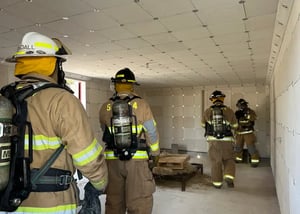
Maximizing Safety, Realism & NFPA 1402 Compliance
When fire departments plan or upgrade a training facility, one of the biggest questions they ask is how to design a burn room that delivers safe, realistic, and repeatable fire training. Burn rooms are the core of any fire training tower, burn building, or modular tower burn room, and getting them right directly impacts firefighter readiness.
At WHP Trainingtowers™, we’ve spent decades designing, engineering, and building high-performance burn rooms that withstand extreme heat cycles, meet NFPA 1402 standards, and deliver real-world fire behavior that prepares firefighters for the toughest calls. This guide shares best practices, answers common questions, and highlights what today’s departments should look for when evaluating their next burn room.
What Makes a Burn Room Effective?
A great burn room must balance realism, safety, and durability. When those three elements work together, trainees get a realistic fire environment without compromising safety or facility lifespan.
Realism + Control
A well-designed burn room creates predictable fire growth, heat movement, and smoke behavior—key components for training search, attack, ventilation, and rescue. But it must also allow instructors to shut down fire quickly and manage risk at all times.
Safety First
A burn room must align with NFPA 1402 compliance for ventilation, thermal protection, fuel sourcing, monitoring systems, and structural safety. Departments also depend on proper airflow control, safe ignition systems, and reliable suppression tools.
Training Effectiveness
The more realistic the environment, the better the outcomes. Firefighters who train in realistic conditions respond faster, stay more situationally aware, and perform with higher confidence on real calls.
At WHP Trainingtowers™, we design burn rooms that check all three boxes—fully controlled, built to last, and engineered for real-world simulation.
Key Elements of a High-Performance Burn Room
1. Structural Materials Built to Withstand Intense Heat
Not all burn rooms are built with the same integrity. WHP Trainingtowers™ uses non-combustible steel framing and high-temperature refractory materials designed for repeated high-heat cycles without warping, cracking, or failing.
We also developed Padgenite™ Interlock, our proprietary liner system built specifically for fire training. It offers:
- Long-term heat resistance
- Reduced maintenance
- Better protection for the structure
- Lower life-cycle cost compared to other liners
This system is a major reason WHP Trainingtowers™ burn rooms last significantly longer than traditional refractory concrete or steel clad alternatives.
2. Fuel System Integration for Controlled & Repeatable Burns
Modern burn rooms rely on gas-fueled ignition systems — usually propane or natural gas — to maintain consistent, measurable heat output. WHP Trainingtowers™ integrates:
- Remote shutoff options
- Precision valves for stable flame control
- Built-in safety redundancies
- Pressure regulation for safe ignition
This ensures every evolution runs the same way, every time.
3. Ventilation & Smoke Management
Realistic smoke patterns help firefighters learn to read conditions. But smoke must also clear quickly for safety and reset cycles. WHP Trainingtowers™ ventilation systems include:
- Controlled smoke release openings
- Positive-pressure relief
- Dedicated exhaust pathways
- Mechanical or passive ventilation depending on facility type
Good ventilation improves both safety and training value.
4. Thermal Protection Systems
Thermal insulation protects the tower structure and prolongs life. Our designs use:
- Multi-layer thermal barriers
- Heat shields at key impact points
- Refractory materials that retain integrity over repeated burns
Proper insulation is also critical for departments pursuing NFPA 1402 compliance.
5. Monitoring & Sensor Technology
Modern burn rooms benefit from real-time monitoring such as:
- Thermal sensors
- Gas monitors
- Flame detectors
- Automated fuel shutoff capabilities
These systems give instructors total oversight—essential for safety and repeatability.
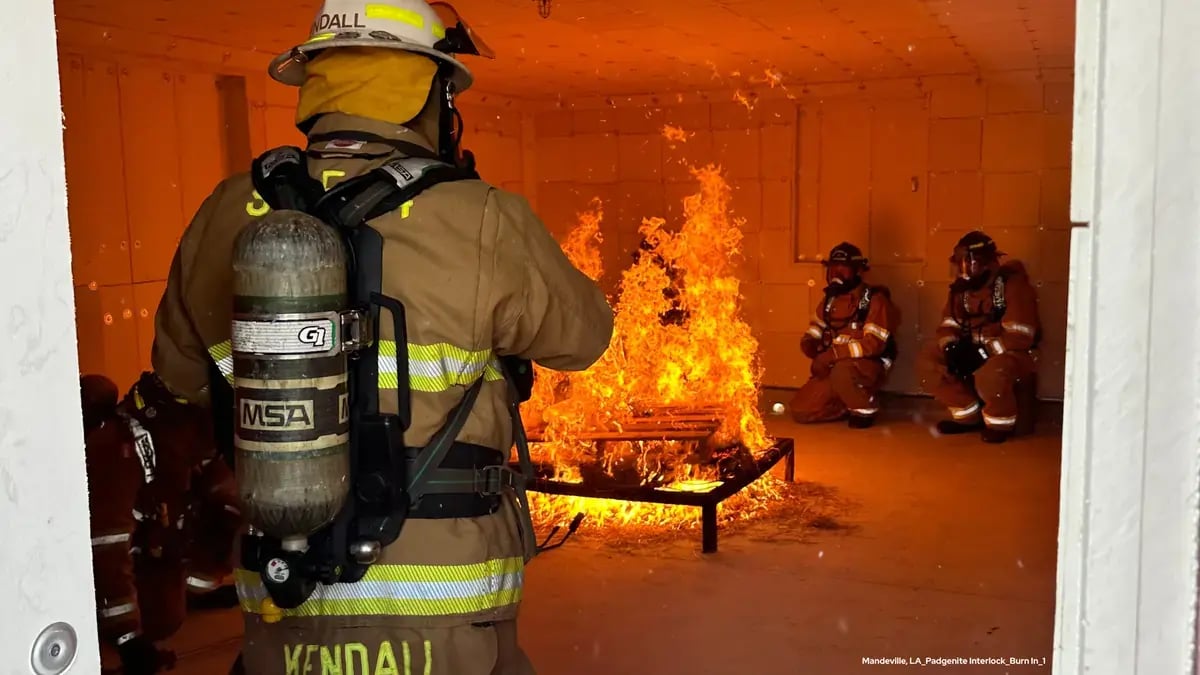
How to Run Safe, Realistic Burn Training
Even with the right room, burn room training must follow a structured process. Common recommendations to consider include:
1. Scenario Planning
Develop evolutions that mirror real-world calls—structure fire attack, search and rescue, vertical ventilation practice, or multi-company drills.
2. Safety Briefing Before Every Evolution
Cover:
- Fuel control procedures
- Ventilation tools and timing
- PPE and SCBA checks
- Escape routes and instructor positions
3. Controlled Ignition
Only trained personnel should ignite and monitor flames. Gas systems make this easier and safer.
4. Structured Debriefing
Firefighters learn best when they review decision-making, communication, and tactics immediately after evolution.
5. Regular Maintenance
After each session, instructors should inspect:
- Walls and liners
- Sensors
- Fuel lines
- Ventilation systems
Burn rooms built with the right materials—like WHP Trainingtower’s Padgenite™—require far less maintenance over time.
WHP Trainingtowers™ Approach to Burn Room Design
For decades, WHP Trainingtowers™ has partnered with departments across the country to engineer high-performance burn rooms and world-class fire training towers. Every structure is built with safety, longevity, and realistic training at the forefront, ensuring that firefighters can train with confidence for years to come.
Modular Burn Room Design
Our modular burn rooms and towers are engineered for streamlined delivery and installation, allowing departments to get up and running quickly. The modular format also supports long-term flexibility — departments can add levels, props, or additional burn rooms as their training needs evolve. This approach delivers scalability without sacrificing quality or compliance.
Advanced Gas Fuel Systems
WHP Trainingtowers™ gas-fueled systems are designed for consistent, repeatable, and controllable training scenarios. With built-in safety features, remote shutoff options, and precision fuel regulation, instructors maintain full control of every burn. This ensures predictable flame behavior while reducing risk, making training safer for both recruits and seasoned firefighters.
NFPA 1402 Guidance
Compliance isn’t optional when it comes to fire training facilities. Our team works directly with departments during planning, engineering, and installation to ensure every design element aligns with NFPA 1402 standards. From ventilation paths to structural integrity, departments receive a facility that meets national safety expectations from day one.
Realism Enhancements
Realistic training improves real-world response. WHP Trainingtowers™ offers smoke distribution systems, interior prop configurations, thermal monitoring, and multiple live-fire room options to customize every scenario. Departments can replicate residential, commercial, and industrial conditions—helping firefighters train exactly how they’ll respond on the job.
Top 5 Questions Fire Departments Ask About Burn Rooms
1. What materials should a burn room be made of?
Burn rooms should be constructed with non-combustible steel framing and high-temperature refractory liners that can handle repeated heat cycles. WHP Trainingtower’s Padgenite™ Interlock system is specifically engineered for this purpose and lasts significantly longer than traditional cement liners.
2. How do I ensure my burn room meets NFPA 1402 compliance?
NFPA 1402 outlines standards for ventilation, fuel systems, thermal protection, safety controls, and structural requirements. WHP Trainingtowers™ designs all burn rooms with these requirements integrated from the start, ensuring departments meet compliance without guesswork.
3. Are gas-fueled burn rooms safer than Class A burns?
Gas systems offer higher consistency, cleaner burns, reduced structural wear, and more control. Many departments prefer them for repeatable training, lower long-term costs, and predictable heat output.
4. How long does a burn room typically last?
A well-built burn room should last decades with routine maintenance. Padgenite™ liners specifically help extend lifespan by reducing heat damage and structural stress.
5. What’s the main difference between a modular burn room and a full burn building?
Modular burn rooms offer flexibility and fast installation. Full burn buildings integrate multiple training rooms and scenarios. WHP Trainingtowers™ designs both depending on the department’s budget, land, and long-term goals.
FAQs About Burn Rooms
Consider the number of trainees, training goals, and future expansion. WHP Trainingtowers™ offers customizable configurations.
Yes. Our team at WHP Trainingtowers™ handles engineering, stamped drawings, and consultation for site planning.
Yes. WHP Trainingtowers™ provides industry-leading warranties on structural components and Padgenite liners.
Absolutely. Many departments retrofit WHP Trainingtowers™ burn rooms into current structures.
Burn room installations lead time varies by configuration, but modular systems offer faster delivery and installation timelines.
Why Fire Departments Choose WHP Trainingtowers™
Firefighters depend on training environments that feel real, function safely, and perform the same way every time. Departments depend on facilities that last, reduce maintenance costs, and deliver measurable return on investment. WHP Trainingtowers™ consistently provides both — and that’s why departments across the country trust our fire fixed tower structures for mission-critical training.
Decades of Specialized Experience
WHP Trainingtowers™ has spent generations designing, engineering, and building fire training towers, burn buildings, and high-performance burn rooms. This isn’t a side service — it’s our core specialty. Every design, weld, liner system, and safety feature is the result of decades of problem-solving alongside fire instructors, chiefs, and training officers across the U.S. and internationally.
NFPA 1402–Aligned Construction
Training environments must meet strict standards to protect crews and maintain operational integrity. Every WHP™ burn room and tower is engineered with NFPA 1402 compliance in mind from day one — ventilation, thermal protection, fuel systems, structural materials, access points, and safety controls. Departments never have to wonder whether their facility meets best-practice guidelines.
Materials Proven to Withstand Real Heat
Fire training structures take abuse. Hundreds of evolutions, repeated exposure to extreme temperature, rapid cooling, and daily wear. WHP Trainingtowers™ uses non-combustible steel construction and proprietary Padgenite™ Interlock liners designed to perform under high-heat cycles for years beyond standard materials. This reduces downtime, limits repair costs, and increases training consistency.
Modular and Fully Customized Options
Every department trains differently. WHP Trainingtowers™ offers both modular tower burn room solutions for quick installation and fully customized multi-level structures designed for advanced scenarios. Whether a department needs one burn room or a full burn building with multiple live-fire cells, search floors, rappelling options, or ventilation props — WHP Trainingtowers™ builds to your goals, your space, and your future expansion.
Industry-Leading Warranties & Long-Term Support
Investing in a training facility is a generational decision. WHP Trainingtowers™ stands behind every structure with one of the strongest warranties in the industry. Our support doesn’t end at installation — departments rely on our team for maintenance guidance, liner replacement, safety checks, and long-term facility planning.
Expert Guidance from Planning to Installation
Many departments don’t build training towers often — but we do.
WHP Trainingtowers™ helps with:
- Site planning and layout
- Engineering and stamped drawings
- Budgeting and grant alignment
- NFPA consultation
- Modular delivery and installation
- Instructor orientation and training recommendations
Fire departments don’t just get a structure — they get a partner.
Our burn rooms aren’t just built to burn — they’re built to train generations of firefighters safely and effectively. With WHP Trainingtowers™, departments gain a facility they trust, a structure that lasts, and a training environment that elevates every firefighter who walks through it.
Ready to Build or Upgrade Your Burn Room?
Whether you're planning your first fire training tower burn building, enhancing a modular tower burn room, or evaluating burn room best practices, WHP Trainingtowers™ is here to help.
Explore our burn room solutions
Compare Padgenite™ vs. other liners
Learn more about NFPA 1402
Schedule a consultation with our team
Visit trainingtowers.com or contact WHP™ directly to start planning a safer, more realistic, more durable training environment.