

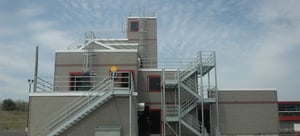
Galvanization provides a protective coating of zinc that prevents premature rust and corrosion. Shipping containers are constructed from weathering steel which is designed to rust immediately creating maintenance issues and structural concerns. This is important in a training environment where water is common. The galvanized MODx structure adheres to ASTM A123 which exceeds the 50-year mark on the “time to first maintenance (TFM)” chart.
Designing and constructing a new fire training facility is a monumental task. From site selection and budget planning to apparatus maneuverability and burn room configurations, the amount of decisions can quickly become overwhelming. While there are countless ways to approach this build, success ultimately relies on more than blueprints and steel.
To successfully navigate these complexities and turn concepts into reality, two elements are absolutely essential:
-
Strong Partnerships: A project of this magnitude requires a trusting collaboration. It takes the combined expertise and dedication of fire service professionals, community stakeholders, specialized designers, and experienced contractors working in tandem to overcome inevitable hurdles.
-
A Clear Vision: With so many potential paths and building options available, a unified vision acts as our compass. When every partner is aligned on the ultimate, shared goal—providing first responders with safe, modern, and realistic training environments they deserve—the noise fades, and a clear roadmap emerges.
The following Frequently Asked Questions (FAQ) are designed to clarify common inquiries, detail our collaborative approach, and define the guiding principles that will take your project from the drawing board to the opening ceremony.
STANDARD QUESTIONS
What is WHP’s track record?
Rather than simply spraying an item with primer, paint, or a galvanizing solution, these metal components are actually dipped into a vat of galvanizing material at a high temperature, assuring complete bonding to the structural members and a long-lasting superior coating that resists corrosion in all types of environments.
Does WHP offer custom buildings?
Each WHP building begins with a clean sheet of paper. We provide base floor plans and elevations as a starting point, but you make the choices about everything from building and room dimensions to window locations, to colors and finishes.
No two fire departments are alike; no two have the same training needs. You are the best judge of your training needs, whether they are for confined space, rappelling, ventilation, ship’s ladders, or other features.
Are roof railings required?
Because OSHA Standard 29CRF.1926.502 states that any working surface more than six feet off the ground requires fall protection, we recommend railings or parapet walls on all roof surfaces that will be used for training.
Remember, not all railings are alike. WHP utilizes OSHA approved railings with toe plates, providing protection for both those on the roof and those below.
We use welded schedule 40 railing and structural steel angles. Our engineers can design railings to meet any local code requirements.
How is the burn room lined?
WHP offers Padgenite™ Interlock. Padgenite thermal insulation has proven itself in the field over 45 years. Properly installed and maintained, we believe it’s the best, most economical system on the market. If we found a better one….we’d be using it.
WHP introduced the Padgenite burn room liner over 45 years ago. When properly installed and maintained, Padgenite is the best and most economical system on the market. We work with clients to “value engineer” a room that will meet your needs as economically as possible. Frequently this involves blending the liner products within a room. Our pre-engineered lining system arrives on-site complete with shop drawings. Tiles are mounted on a grid of galvanized hat channels with spaces between the panels to allow for thermal expansion. Built into the system is an additional insulating air space between the panel and wall of the structure. When burning in one of our metal buildings, the Padgenite, coupled with the air space, insulates so effectively that you can touch the outside of the building.
How is temperature build-up within the burn room controlled?
We recommend the use of temperature monitoring devices within the burn room and offer a number of different models. Thermocouples placed at ceiling level and working level allow you to monitor temperatures and can greatly extend the life of the burn room panels.
Can gas-fired simulators be added to WHP training buildings?
WHP works with all the major simulator companies, both in new buildings and retrofits. Our experience working with propane/natural gas simulators makes for a seamless installation process.
What type of stairs and railings are provided and why does it matter?
There are two issues to consider when looking at stairs and railings, how closely they approximate real-life conditions, and the quality of the system itself.
WHP uses stair designs that meet your local code requirements as they relate to NFPA 1400. Stairs and railings are made from structural steel members welded together for superior strength and longevity.
Stair treads are hot-dipped galvanized bar grate with checker plate nosing, providing a slip-resistant and maintenance-free stair.
Code specifies that the components of the stair/railing system must be welded, not bolted together and that the railing needs to be smooth.
Can I add on to the building later? Can I move it?
It is easy to add anything from a burn room to an additional structure at any time after the building is completed. It is even possible to disassemble the entire structure and relocate it to another site if necessary.
FIXED TRAINING TOWER QUESTIONS
Tell me about the building.
Our building was designed solely for the purpose of training fire and emergency service professionals.
WHP uses a proven building system introduced in 1949. It consists of hot-dipped galvanized structural cladding with 4.5” deep corrugations embedded with a series of smaller corrugations. This “compound” corrugation enhances the strength of the cladding such that the support strength of a WHP panel can equal that of a steel girder of the same length and weight.
Panels are 13-18 gauge (much thicker than found in most commercially available metal buildings). The system offers the advantage of being able to span distances of up to 300 feet without the need for interior columns, making it a perfect choice for customers needing open spaces and enhanced design flexibility.
To meet the demands of the fire service, we further strengthened the building by adding a secondary framing system of heavy gauge steel columns. Without structural modification, our building system is capable of meeting the most stringent wind load and seismic requirements in the country. We’ve been through hurricanes and tornadoes in Florida, Guam, North Dakota – and we’re still standing.
How are WHP buildings constructed?
The building process begins with the erection of the internal framework of structural columns and floor joists.
Structural cladding is attached to the structural columns and joined together with 3/8″ diameter bolts (each able to support 1,400 pounds) at 6″ intervals.
Seams are sealed with top quality elastomeric strip caulking, making the building weather tight, and virtually light-tight.
NO OTHER TRAINING TOWER PROVIDER routinely seals each and every seam.
Why would I want a metal building instead of concrete?
The simple answer is that metal proves far superior to concrete when it comes to withstanding the punishment of repeated heat-cool cycles that come with fire training.
A metal structure is homogenous. It expands and contracts in response to temperature changes at a given rate up and down the entire length. Concrete buildings are composed of reinforced steel encased in cement aggregates – each material expands and contracts at a different rate throughout the heat-cool cycle.
This constant stress sometimes results in structural damage of such a magnitude that it is condemned.
A metal WHP building typically costs 40-60% less than a concrete or block building.
What you save by using steel can allow you to have a larger building with more training options.
Even more important than the initial cost of a fire building are its long-term maintenance costs and durability. We frequently receive calls from fire departments that have a concrete or brick & block building that has been condemned because it has become structurally unsound.
Metal buildings require minimal maintenance beyond basic upkeep. We never expect to have to replace a metal building. A damaged panel can simply be unbolted and replaced with a new one.
Proper maintenance of a concrete structure involves treatment with a waterproofing agent and ongoing reviews by structural engineers to verify that the building is structurally sound. Should the building be damaged, repairs are at best costly, at the worst, impossible.
Forty years ago there were no choices. Concrete was the only offering on the market. Today, you can choose.
A metal structure is homogenous. It expands and contracts in response to temperature changes at a given rate up and down the entire length. Concrete buildings are composed of reinforced steel encased in cement aggregates – each material expands and contracts at a different rate throughout the heat-cool cycle.
This constant stress sometimes results in structural damage of such a magnitude that it is condemned.
A metal WHP building typically costs 40-60% less than a concrete or block building.
What you save by using steel can allow you to have a larger building with more training options.
Even more important than the initial cost of a fire building are its long-term maintenance costs and durability. We frequently receive calls from fire departments that have a concrete or brick & block building that has been condemned because it has become structurally unsound.
Metal buildings require minimal maintenance beyond basic upkeep. We never expect to have to replace a metal building. A damaged panel can simply be unbolted and replaced with a new one.
Proper maintenance of a concrete structure involves treatment with a waterproofing agent and ongoing reviews by structural engineers to verify that the building is structurally sound. Should the building be damaged, repairs are at best costly, at the worst, impossible.
Forty years ago there were no choices. Concrete was the only offering on the market. Today, you can choose.
Describe the Building process and Turn-around time?
WHP is a full-service builder and supplier, capable of erecting a complete turnkey project. You have one contact— WHP — and we have control of the project from the time it leaves the drawing board until you sign off on a finished product.
Any problems, we handle them – from early planning phases until break-in of the completed tower.
We have multiple crews, so we can easily handle several tower projects at one time. WHP installers are specialists and ONLY build WHP buildings.
Completion time generally runs 4-8 weeks. Our experience shortens the installation time so that you can take possession sooner.
What type of foundation is required?
The unique design of WHP buildings eliminates the need for interior columns. This is important because it allows linear loading to be spread across the foundation. Except in the poorest of soil conditions, this eliminates the need for column piers and footings – saving you time and money without compromising strength.
What about floors?
“When was the last time you crawled on a steel deck floor in a fire?”
Rugged, low maintenance concrete flooring comes standard throughout our buildings. Concrete floors provide the best long-term usage.
Smooth concrete floors are realistic and firefighter friendly, saving wear and tear on bunker gear.
Our building is designed to handle the additional weight of 4” poured concrete without reducing load limits.
Are WHP buildings weather tight, and why is that important?
WHP IS THE ONLY SUPPLIER WHO OVERLAPS AND SEALS EVERY SEAM.
A weather-tight building is very important. This keeps weather and wildlife – hazardous and destructive conditions – out of your building. A weather-tight building allows training year-round.
This weather-stripping also provides a closed seam and a dark interior. No matter how hard you hit the panels with an air pack or ladder during training exercises, the seams won’t separate. You won’t see light coming in.
WHP cladding is bolted together at 6” intervals by heavy-duty bolts (each capable of supporting 1400 pounds). The bolt holes are pre-drilled at the factory to prevent rust. High-quality weather-stripping seals are applied in the field at every seam.
Conventional metal buildings offer horizontal siding. Often these pieces overlap or interlock, but aren’t sealed. This siding is attached in the field by self-tapping screws. Each of these field-drilled screws creates a raw, new hole. Each new hole exposes un-coated metal which in turn creates a potential rust area and unsightly streaking.
What type of roof is used on the building?
We provide the roof that best suits your training needs, including a flat roof with railings, sloped roofs at whatever pitch you choose, double-pitched roofs (allowing training at two different angles on the same roof area) or any combination.
For ventilation exercises, most of our customers find that using a roof made of composition shingles with replaceable chop-out hatches provides a more realistic experience. Our chop-out hatches are flush with the roof, avoiding tripping hazards from raised curbs.
How long will the building last?
Our first structure was built in the early 1980s in Kotzebue, AK. Over 45 years and still going strong!
MODx MODULAR™ TRAINER QUESTIONS
How high can you stack the MODx?
MODx Modular™ is pre-engineered for up to five stories, however, depending on the specific needs of the customer, more stories are possible.
What makes the MODx different from containers?
The strength of the MODx comes from its fully galvanized steel structure that allows for open floor spaces. Where shipping containers use walls for structure, the interchangeable walls, doors, and windows on the MODx are not utilized for structure. The MODx is made from ALL-NEW materials and is made for fire training thus outlasting any other modular product on the market.
Is MODx available in different sizes?
The standard MODx module is 8’x20’”. Modules can be stacked, positioned, and aligned in an infinite amount of configurations to fit your training needs.
Where is the MODx made?
The MODx is manufactured in Grandview, Missouri, USA. The fact that modules can be pre-assembled and shipped to areas of high prevailing wage, saves money in the manufacturing process.
What is the benefit of the MODx being galvanized?
One Purpose, One Passion
Our training towers are designed by firefighters and engineers specifically for fire training.
No other company in the world has built as many metal training towers as WHP. We’re not just a supplier of fire training towers. We’re fire training experts. Designing, fabricating, and installing a better solution for your training grounds is what we do.