

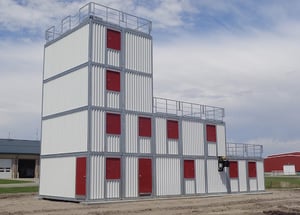
Designing a fire training facility project usually starts with a clear picture in mind.
Most departments start with the training they’ve gone through and what’s required for certification. ISO rating expectations often come into play as well, shaping a plan built around a tower and a handful of core training elements.
That’s only part of the story.
Decisions around utilities, layout, and long-term use don’t always get the same attention up-front, and those are the ones that tend to cause problems later.
Planning ahead gives departments more flexibility as training needs evolve, while making it easier to add new elements without overhauling the structure.
This guide walks through the process and highlights where planning gaps tend to show up.
Where Gaps Show up in Fire Training Facility Design
Most departments don’t start from scratch.
They already have a general idea of what they need. That usually shows up as a focus on core training elements and a tower-based layout.
The issue is that this only covers the visible pieces.
What gets missed early are the decisions that shape how the facility offers value in 2, 10, and 20 years. Planning around utilities and space doesn’t always get worked through at the same level, which is where limitations tend to show up over time.
That’s where projects start to run into problems.
What to Define Early in Fire Training Tower Design
Before drawings or layouts, a few things need to be clear.
This is where strong projects separate from the ones that struggle over time.
Start with:
-
Training scope: What scenarios does the facility need to support?
-
Site and space: How much land is available, and is there room to expand?
-
Utilities: Will water, power, and gas support both current needs and future additions?
-
Budget and phasing: What gets built now, and what may need to come later?
This is where that initial plan gets tested against real constraints, and gaps in the plan start to show.
From there, work through a few questions:
-
Stakeholders and goals: Are decision-makers aligned on what the facility needs to accomplish?
-
Codes and compliance: What NFPA standards and local requirements apply to the design?
-
Operations and safety: How will training be run, and what does long-term maintenance look like?
-
Risk and long-term use: What could limit the facility later if it’s not addressed now?
Fire Training Facility Design Phases: Vision to Construction
Most fire training facility projects follow a similar path. Understanding each stage makes it easier to plan ahead and avoid issues along the way.
Phase 0: Vision, Governance, and Budget
This is where the project takes shape. Early decisions here tend to carry through the rest of the build.
Start by clarifying how the space will be used. That usually comes down to how the department trains today and where that training is headed. Some programs are built around live fire. Others spend more time on technical or scenario-based work. The mix will shape how the facility needs to function day to day.
Decision-making rarely sits with one group. The fire department may lead, but other voices often influence the direction of the project. Requirements, training goals, and outside input all tend to shape how the facility is planned.
A few questions help guide early planning:
-
What is the realistic budget range?
-
How will success be measured once the facility is in use?
-
What standards or requirements need to be met?
Budget decisions should reflect how the facility will be used now and what may come later. Early assumptions tend to carry through the project.
Phase 1: Site Selection and Feasibility
Not every site will support what you want to build, and those early decisions tend to shape how the facility performs over time.
Location is part of that. A site in a more developed area brings a different set of constraints than one with more space, and access to water and utilities can limit what types of training are possible.
That’s where space starts to matter in a different way. It’s not about what fits today. It’s about whether the site can handle future additions without forcing major changes later. If that flexibility isn’t considered early, expansion can become much more difficult.
Environmental conditions can also shift the direction of the project. Site limitations, surrounding areas, and local requirements can all influence how the facility is built and how it operates day to day.
As options are narrowed, the focus shifts from what could work to what will work. A smaller group of sites is reviewed more closely to understand how each one will function once the facility is in place.
The goal is to identify a site that supports current needs and still leaves room to grow.
Phase 2: Program Definition and Schematic Design
This is where training needs start to take shape as a physical plan. What was discussed early on now begins to show up in how the facility is laid out and used.
At this stage, the focus shifts toward how the space will function day to day. That includes how training areas connect, how people move through the site, and how different activities are supported.
A few elements begin to take shape here:
-
Training spaces and how they are used
-
Layout of props and support areas
-
Site circulation and staging areas
-
Early safety planning and risk considerations
Input from instructors and stakeholders becomes more important as the plan develops. Their feedback helps refine how training will actually take place in the space.
Early layouts and site concepts start to come together, giving a clearer picture of how the facility will operate once everything is in place.
Phase 3: Design Development and System Planning
The concept gets more detailed as systems are refined and coordinated so the facility can support how training will be run day to day.
-
Structural systems and layout are refined
-
Training props and features are defined
-
Safety and operational needs are addressed
This is also where flexibility should be built into the design, before decisions start to limit what can be added as needs change.
Phase 4: Construction Documents and Engineering Detail
This is where the design is fully defined and prepared for construction. The project moves from concept into a set of documents that can be built from.
The work becomes more detailed:
-
Structural elements are finalized
-
Building systems are worked through
-
Fire protection planning is carried into the design
-
Burn facilities are defined based on how training will be conducted
-
Prop requirements are documented for fabrication and testing
Supporting systems are addressed as part of how the facility will function. That includes how decontamination areas are set up and how waste is handled during training.
By the end of this phase, the project is documented in a way that allows it to move into construction with fewer unknowns. Changes after this point become more difficult and more expensive.
Phase 5: Procurement, Permitting, and Construction
The project moves into execution. Work on site begins, and earlier planning decisions start to take shape in the field.
-
Secure permits and approvals
-
Coordinate construction
-
Maintain quality and safety standards
Phase 6: Commissioning and Training Readiness
The facility is prepared for use. Systems are tested, and staff are prepared to operate the facility. Training scenarios are reviewed to confirm everything functions as expected.
The focus shifts to real use. Systems are run to confirm they operate as intended, and training scenarios are worked through in practice. Instructors and crews are brought in so they understand how the facility will be used.
That work typically includes:
-
Testing utilities, props, and control systems
-
Running live-fire scenarios under supervision
-
Aligning training programs with facility use
-
Training instructors and crews on operations and safety procedures
Documentation is finalized as part of this process, including operating guidance, maintenance planning, and updated drawings.
At this point, the facility is ready for occupancy and can support training.
Phase 7: Operations and Continuous Improvement
The project doesn’t stop once construction is complete.
-
Monitor how the facility is used
-
Adjust training over time
-
Plan for future additions
This is where early planning decisions continue to show their impact. The way the facility was designed affects how easily it adapts as training needs change.
The Part Most People Miss: Planning for What Comes Next
This is where flexibility either gets built in or lost.
A lot of the early focus goes toward getting the structure built. What doesn’t always get the same attention is how that structure will evolve years from now.
Utilities are one of the first places this shows up. Planning only for current needs can make it difficult to add new training elements, and expansion may require rework that could have been avoided.
Where this shows up:
-
Utility limits: water and power sized for today, not for future training demands
-
No connection points: no conduit or access planned for future structures or props
-
Tight layouts: no room to add new elements without disrupting existing training areas
These are easy decisions to make early. They’re much harder to fix once the project is underway.
With proper planning, you can:
-
Support new training elements
-
Integrate new props without major rework
-
Expand the facility without disrupting operations
Decisions made early determine how easy it will be to expand as needs change.
How to Design for Expansion Without Overbuilding
Planning for the future doesn’t mean building everything now. It means making sure the structure can support what comes next. This usually comes down to a few design decisions that don’t stand out early.
Structure
Your department may not have the budget for additional props today.
If the structure isn’t designed to support that weight, adding new elements becomes a much bigger project than expected. In some cases, even a new platform or prop may require structural reinforcement before installation.
Designing with that load in mind early keeps those options open without adding complexity down the line.
Vertical Expansion
If future platforms or levels aren’t considered early, adding them can require structural changes you could have avoided.
Even something as simple as adding a stair system or extending training levels can turn into a larger project if the structure wasn’t designed for it. Planning for vertical growth early makes it easier to build on what’s already there.
Layout
If you don’t set space aside for future elements, new additions can interfere with existing training scenarios.
Training areas that feel open at first can become constrained over time. Adding new props or structures may disrupt how the space is used, forcing adjustments that could have been avoided with better spacing early on.
These decisions are simple during planning. They shape how usable the facility will be years down the line.
5 Mistakes That Limit Facility Performance
Many of the challenges with fire training facilities trace back to early planning decisions. Those choices shape how the facility performs over time.
1. Planning only for current needs
A facility may be designed around today’s training requirements and budget. That works in the short term. As training needs change, the facility can start to limit your team’s growth as firefighters.
2. Underestimating utilities
Water, power, and gas are often planned around immediate use. When future demand isn’t considered, expansion can be restricted. Adding new props or systems may require upgrades that could have been avoided earlier.
3. Overlooking structural capacity
If the structure isn’t designed to support additional weight, expansion options become limited. Adding platforms or props can require reinforcement or redesign.
4. Tight or inflexible layouts
Space that works well at the start can become restrictive over time. New elements may interfere with existing training scenarios. This can reduce how effectively and efficiently the facility is used.
5. Delaying planning decisions
Some choices get pushed off. Once design is finalized or construction is underway, those changes become harder and more expensive to make.
What a Well-Planned Facility Looks Like in 5 Years
A well-planned facility holds up under changing demands. NFPA 1400 also calls for a 5-year structural inspection, which gives departments a clear checkpoint to evaluate how the facility is holding up and where adjustments may be needed.
As training programs evolve, the space continues to support new scenarios without major disruption. New elements can be added without reworking existing structures.
Over time, that shows up in a few ways:
- New props can be integrated without major construction
- Training areas remain usable as needs shift
- Expansion happens in phases instead of large overhauls
Daily use also stays consistent.
Training can run without constant adjustments to work around layout limitations. Maintenance stays predictable because systems were planned with long-term use in mind.
These outcomes are tied to decisions made early.
Fire Training Facility Design That Can Take the Heat
Fire training facility design decisions carry forward into every phase of use. What gets planned early determines how the facility performs, how it adapts, and how far it can evolve without major changes.
Facilities built with that in mind stay usable as training demands shift, without constant workarounds or costly upgrades.
Keep the Fire Going
Dive deeper into training facility design and planning in our Blog Library.
